This page covers repairs to existing siding. If most of your siding is failing, see vinyl siding replacement and the cost guide. For damage at the roof edge, see soffit, fascia and eavestroughs.
Common siding problems after a Moncton winter
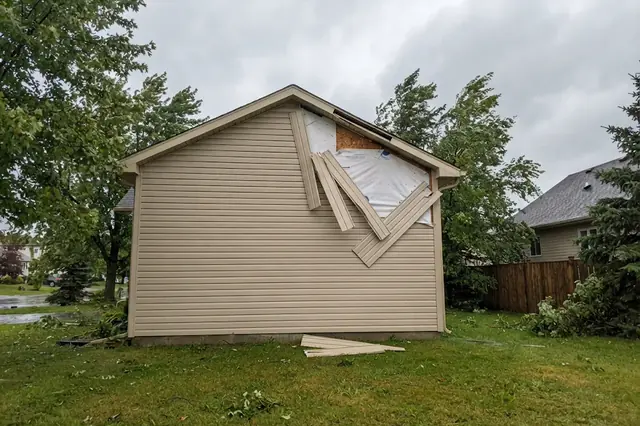
- Panels blown off or hanging loose after a windstorm, usually at corners, gable ends and the top course.
- Cracked or holed vinyl from impacts in cold weather, when standard vinyl is brittle: snowblower gravel, ladders, balls and pucks.
- Buckled or wavy panels that were nailed too tight to move.
- Melted vinyl near barbecues, or from sunlight reflected off a neighbour’s low-E windows.
- Dented or chalky aluminum on older houses.
- Gaps at J-channel and corners where panels have shrunk back and let water behind.
- Soft or swollen wood-fibre boards where water has been getting in at a cut end or behind trim.
How a vinyl repair works
Vinyl panels lock into each other. With a siding zip tool, the panel above the damage is unlocked and lifted, the nails on the damaged panel come out, and a new panel slides in, gets nailed loose in its slots, and locks back into place. Nothing is caulked or glued over.
Before any panel goes back, we look behind it. Loose siding often means water has been getting at the house wrap and sheathing, and a soft spot is cheaper to fix now than after another winter.
Matching an old colour
Vinyl fades, and colours get discontinued. A brand-new panel in “the same” colour can stand out next to ten-year-old siding. A few ways around it:
- Bring a piece to a supplier and match it as closely as possible. Sometimes it’s close enough.
- Take matching, weathered panels from a wall nobody sees, such as behind a deck or the back of a garage, and put the new panels there instead.
- If the damage is a whole wall, re-side just that elevation in a colour that works with the rest, and treat it as a deliberate accent.
Siding damage after a storm? Send a photo or call.
Call (506) 405-9905Repairing aluminum siding
Aluminum is harder to patch than vinyl. Panels can be replaced, but matching profiles is often difficult on older houses. Small dents can sometimes be left or filled and painted. Chalky, faded aluminum can be cleaned and repainted with a paint made for metal siding, which can buy a lot of years.
If the aluminum is badly dented and the profile can’t be matched, replacing the siding on that wall, or the whole house, may make more sense. We’ll give you both prices.
After a windstorm
- Take photos of every damaged wall from the ground before anything is moved. Your insurer will want them.
- Pick up loose panels and keep them. They’re useful for matching.
- If house wrap or sheathing is exposed, a temporary cover keeps rain out until the repair. Don’t climb a ladder in high wind to do it.
- Call your insurer to ask about your coverage, then call us for a written repair estimate.
Southeast New Brunswick gets its share of big blows. Post-tropical storm Fiona in September 2022 tore siding off houses across the region. Repairs after storms like that are a good time to check the rest of the wall too.
Repair or replace?
Repair usually makes sense when the damage is limited to one or two walls and the rest of the siding is sound. Replacement starts to make sense when:
- panels are cracking or loose all over the house, not in one spot;
- the colour can’t be matched and the damage is on the front;
- there are signs of water behind the siding on several walls;
- you were thinking about new siding anyway.
We’ll tell you which one we’d do on your house, and price both if you want to compare.